
In 1977, a French motorcycle racer named Thierry Sabine got lost in the Ténéré desert during a rally called Abidjan-Nice. Lost badly — the kind of lost where you start rationing water and stop being angry and just get quiet. He survived. And then he did the thing only a certain kind of person does after nearly dying somewhere: he decided everyone should experience it. A year later, the first Paris-Dakar Rally rolled out of France, aimed at Senegal, through sand that didn’t care about anyone’s plans. That’s the whole spirit of the Dakar Rally in one story. It was born from getting lost, not from winning.
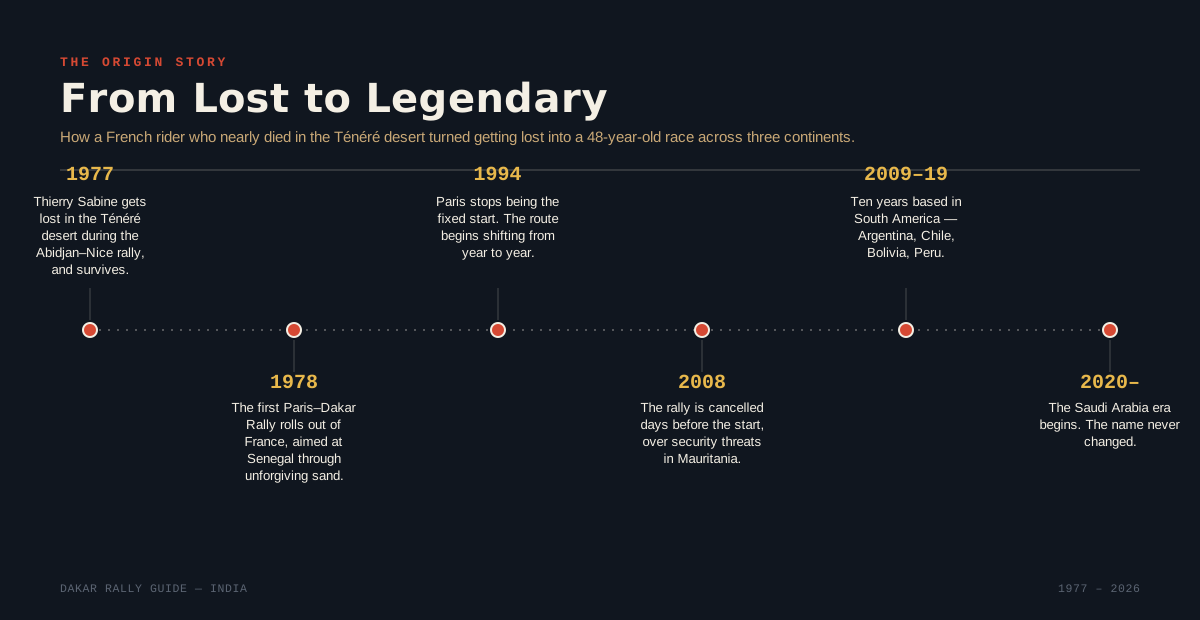
Today the race is called simply the Dakar Rally — it hasn’t touched Dakar, Senegal since 2007, having moved to South America for a decade and then to Saudi Arabia since 2020, but nobody bothered renaming it. Some names just stick.
The in-between years are their own story. Paris was the regular starting point until 1994, after which the route kept shifting, and the event stopped being called “Paris-Dakar” and became simply “the Dakar”. The 2008 edition was cancelled outright, days before the start, over security threats in Mauritania, and from 2009 the rally shifted its entire operation to South America-Argentina, Chile, Bolivia, Peru- for the next ten years, before organisers struck a deal to move the whole circus to Saudi Arabia from 2020 onward. Three continents, one race, same stubborn name.
What Is the Dakar Rally?
Forget everything you know about Formula 1 or MotoGP. Dakar isn’t a track race. There’s no lap, no circuit, no crowd lining a corner. It’s a cross-country rally raid — riders and drivers cover somewhere between 7,000 and 9,000 kilometres over roughly two weeks, through dunes, rocks, dry riverbeds, and stretches of nothing that go on long enough to make you talk to yourself. You navigate with a roadbook, not a GPS screen full of turn-by-turn instructions. A roadbook is basically a scroll of hand-drawn notes and distances that unrolls on a little motor in front of you as you ride. Miss a waypoint, misread a dune direction, and you could be adding fifty kilometres of pure guesswork to your day. People have gone missing for hours. A few, tragically, have not come back at all, since 1979, 79 people are known to have died as a result of the Dakar Rally, 33 of them competitors and the rest support crew, journalists, spectators, and even the race’s own founder, That’s not a footnote. It’s why finishing, not winning, is treated as the real achievement.
Since 2022, Dakar also anchors the FIA/FIM World Rally-Raid Championship (W2RC), a season-long series with a handful of other events feeding into it. Dakar is still the crown jewel — the one everyone actually remembers — but points earned here count toward a bigger, year-long title too.
Dakar Rally Format and Stages Explained
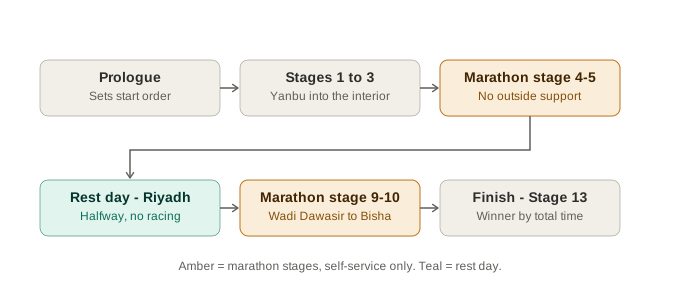
Dakar 2026 ran 3–17 January, out of and back into Yanbu on Saudi Arabia’s Red Sea coast, with a Prologue stage plus thirteen full stages- fourteen days of racing in total. The Prologue is short, sometimes under 20 kilometres, and its only job is to set the starting order for Stage 1. Get a good Prologue time and you start further up the pack the next morning, which matters a lot — being first through virgin dunes is very different from being fiftieth through dust kicked up by everyone ahead.
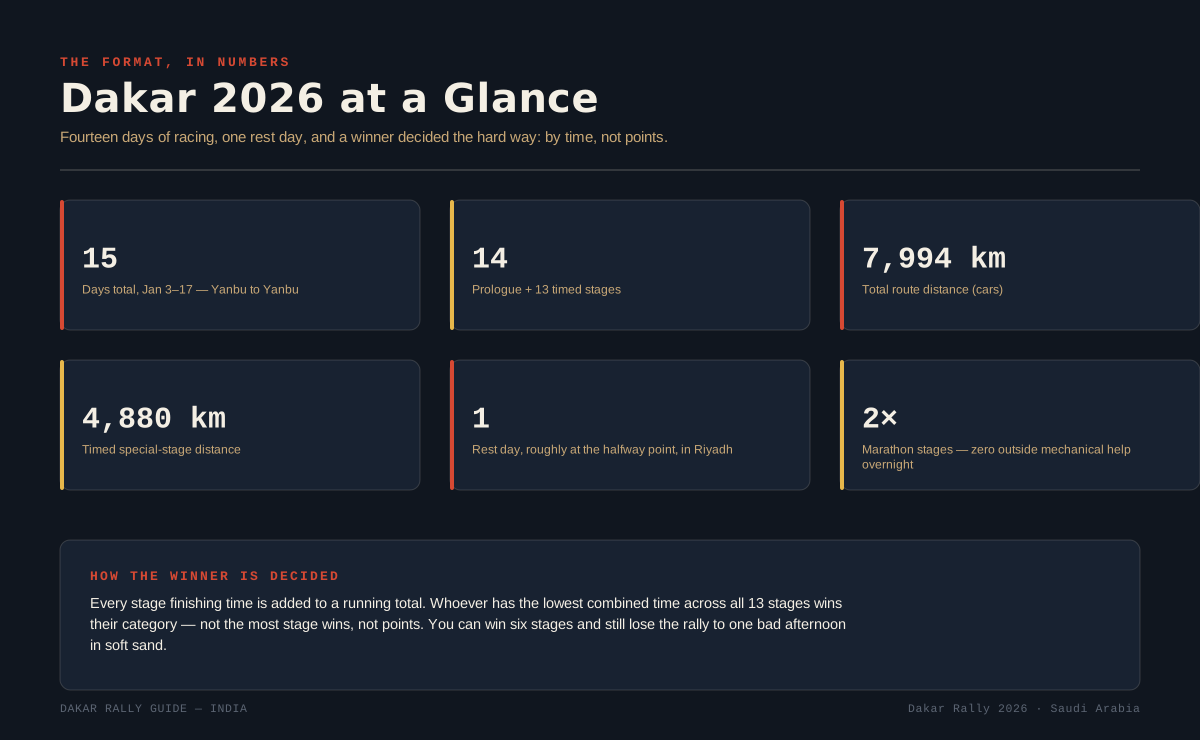
The 2026 edition covers 7,994 kilometres for the cars category, of which 4,880 kilometres are timed special stages, the rest being transport sections between bivouacs-making it one of the longest routes in recent Dakar history. There’s a rest day roughly midway, in Riyadh, which sounds luxurious until you remember competitors spend it not resting but stripping engines and re-taping fingers.

Winners are decided purely on cumulative time, not points, not stage wins stacked up — this is the single most-searched question about the Dakar Rally winner format, so worth spelling out plainly. Every stage’s finishing time gets added to a running total;the overall winner of each category is simply whoever has the lowest combined time when Stage 13 ends. You could win six stages outright and still lose the rally if you crashed once and lost forty minutes digging your bike out of soft sand. That’s the brutal fairness of it – consistency beats brilliance, almost every year.
The marathon stage — two straight days with zero outside help — returns to its old format for 2026 after organisers scrapped the 48-hour chrono stage that had caused a crash-heavy 2025 edition. It shows up twice on the 2026 route: stages four and five through Al Ula and Hail, then stages nine and ten through Wadi Ad Dawasir and Bisha. On marathon nights, mechanics from your own team aren’t even allowed near your machine at the bivouac. You fix your own puncture, or you don’t fix it.
Seven categories run alongside each other on the same roadbook, same stages, same dunes: bikes, cars, Classic, Challenger, M1000, SSV, and trucks. Bikes, cars, and trucks go back to the very first edition. The cars category — often just called “4×4” in India because every serious machine in it runs four-wheel drive – is where names like Nasser Al-Attiyah, Carlos Sainz, and Yazeed Al-Rajhi have made their careers, hammering Toyota Hiluxes, Audis, and Ford Raptors across dunes at speeds that shouldn’t be legal on sand. Challenger (T3) and SSV (T4) — the lighter, buggy-style off-road machines — were added in 2017. M1000 is the newest addition, reserved for vehicles running alternative or hybrid drivetrains, basically Dakar’s answer to “what happens when the desert meets an electric motor.” Classic is for genuinely old 4x4s and rally cars from past decades, split into groups like T5 and the high-average-speed H-classes, driven by people who clearly enjoy pain with a side of nostalgia.

Within bikes there’s also the Malle Moto class — riders who carry their own spares in one metal trunk and service their machines themselves every night, no support truck, no mechanic, nothing. Old Dakar hands still call this the only “real” way to do the rally. Ricky Brabec, Daniel Sanders, the Benavides brothers — none of them ride Malle Moto anymore, they’re on factory programmes with full support crews, but the class survives because privateers keep signing up for the harder version on principle.
Every evening the whole caravan lands at the bivouac — a tent city built and dismantled daily, part garage, part hospital, part mess hall, mechanics working under floodlights till 2 a.m., physios taping up wrists that took one dune landing too many. There’s a strange, exhausted camaraderie in a bivouac you won’t find anywhere else in motorsport.
How to Participate in the Dakar Rally
Here’s the part most people skip past. You don’t sign up for Dakar the way you’d register for a marathon. Organisers require competitors to hold a valid FIM (for bikes) or FIA (for cars) cross-country rally licence, and nobody hands that out for showing up. You earn it by racing and finishing recognised rallies first.
The usual ladder looks something like this:
Start with enduro or desert riding at home — real off-road hours on sand and rock, not weekend trail rides.
Move into a national or regional cross-country rally. In India that means the Rally de Himalaya (which has its own 4×4 class), Maruti Suzuki Desert Storm in Rajasthan, the India Baja, or the K1000 Cross Country Rally in Kutch — all proper 4×4 and bike off-road events where Indian teams like Mahindra Adventure and Force Motorsport cut their teeth.
Step up to an international qualifying event — Merzouga Rally, Sonora Rally, Africa Eco Race — where FIM/FIA points actually get awarded.
Accumulate enough points and finishes, then apply for a Dakar entry through ASO (Amaury Sport Organisation, the French company that runs the whole show).
It’s less “fill a form” and more “spend three to five years proving the desert won’t break you first.”
Arrangements Needed to Participate in Dakar Rally
Getting an entry number is maybe 20 percent of the job.
The rest:
A homologated machine. Your bike or car has to meet Dakar’s technical regulations — fuel tank capacity, roll cage specs for cars, GPS tracking and satellite tracker fitment, medical kit, fire extinguisher, the works. You can’t turn up on a showroom bike.
Roadbook and navigation gear. A roadbook holder with its own motor, tripmeter, compass — all mandatory kit, and all things a rookie needs practice reading under pressure, at speed, while airborne over a dune crest.
Medical and repatriation insurance. Non-negotiable. ASO requires proof of cover, and given the terrain, you want it to be real cover, not the cheapest policy you found online at 1 a.m.
Vehicle and personal freight. Machines get shipped or trucked to Saudi Arabia ahead of scrutineering, and shipped back after. This alone is a logistics project.
A support crew or a Malle Moto entry. Cars and trucks need a full assistance team following the route with spares and mechanics. Bike riders can go Malle Moto (self-supported, carrying spares in one trunk) to cut costs drastically, or hire assistance.
Physical prep. Riders train for months — core strength, wrist and shoulder conditioning, heat acclimatisation. People who treat this as an afterthought usually don’t finish.
Scrutineering and administrative clearances. Vehicle inspection, licence verification, visa and customs paperwork for Saudi Arabia — all completed in the days before the start.
Dakar Rally Cost and Entry Fee (India Perspective)
This is the number that stops most dreams before they start, so here it is straight, no sugar-coating.
The official entry fee alone, for the current edition, runs roughly €20,400 per rider in the motorcycle category, while car categories such as Ultimate, Stock, Challenger and SSV sit at about €32,650 per vehicle, and trucks at around €45,900 — that’s the fee just to be allowed on the start ramp, before a single litre of fuel or spare tyre is bought. In rupees, at rough conversion, that’s somewhere near ₹18–19 lakh for a bike entry and ₹30 lakh-plus for a car.
But the entry fee is the smallest line in the budget. Add up bike or vehicle cost, spares, freight both ways, insurance, crew wages and travel, fuel, accommodation before and after, and training expeditions in the lead-up months, and a privateer motorcycle rider typically needs somewhere between €80,000 and €100,000 to actually complete the rally, while car teams usually operate between €200,000 and €500,000 depending on how serious the support structure is. Truck campaigns can run past half a million euros, occasionally close to a million, for the more complete factory-level operations. In Indian terms, even the “cheap” version — a self-supported bike privateer- is a ₹70–90 lakh commitment once everything is totalled. And prize money for category winners is almost symbolic against these numbers- around €5,000 for first place, €3,000 for second, €2,000 for third. Nobody does Dakar for the cheque.
Which is exactly why sponsorship is the real skill here, arguably more than riding. Every Indian rider who’s made it to that Yanbu start line has spent as many hours chasing brand backing as they have chasing kilometres in the saddle.
Dakar Rally India: Sanjay Takale and the 4×4 Story
For a long time Dakar felt like something that happened to other countries. That changed in 2015 when CS Santosh became the first Indian to finish the rally on two wheels, riding for the Sherco TVS factory team — a moment that got replayed on Indian sports channels for weeks. Since then TVS Racing and Hero MotoSports Team Rally have kept Indian colours on the Dakar grid almost every year, with riders like Aravind KP, Ashish Raorane, and Harith Noah clocking finishes and, on a good year, top-twenty stage results against the best desert riders on the planet. Hero’s rally bikes are even developed and tested partly out of facilities in India before they touch Saudi sand.
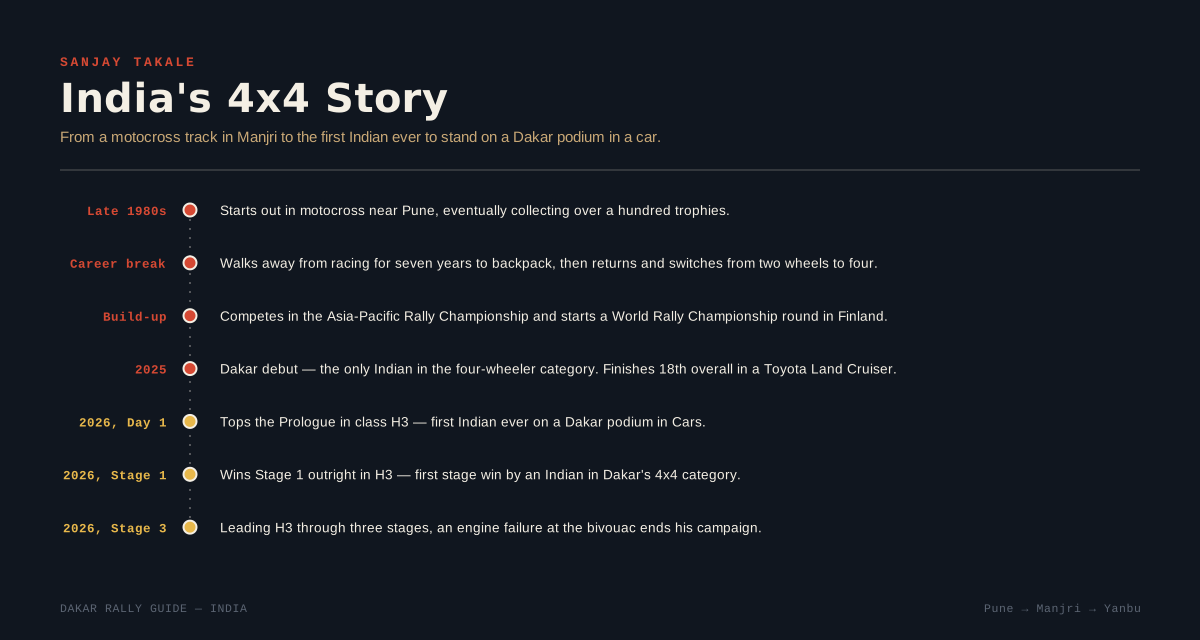
The 4×4 side of that story belongs to one man: Sanjay Takale. A Pune-based driver from the village of Manjri, Takale started out in motocross in the late 1980s, picked up over a hundred trophies, walked away for seven years to backpack, and came back to switch from two wheels to four — a decision that eventually carried him through the Asia-Pacific Rally Championship and even a World Rally Championship start in Finland.
He made his Dakar debut in 2025 as the only Indian in the four-wheeler category, finishing 18th overall and 10th in the Dakar Classic class, driving a Toyota Land Cruiser- the first Indian ever to complete Dakar on four wheels.
He went one better at Dakar 2026: Takale topped the Prologue in the high-average-speed H3 group, becoming the first Indian to stand on a Dakar podium in the Cars category on Day 1, and then followed it up by winning Stage 1 outright in his class — the first stage win by an Indian in Dakar’s four-wheel category, ever.
He led H3 through three straight stages before an engine failure at the Stage 3 bivouac forced him out of the rally he was leading. Bittersweet, but the record stands – an Indian driver, in a 4×4, beating the field on Dakar’s biggest stage.
It’s still a small club. Dakar demands money, sponsorship, and a support ecosystem that Indian motorsport is only just building. But every finish moves the needle — every Indian rider crossing that final podium in Shubaytah or Yanbu tells the next kid in some small town with a dirt bike or a modified Gypsy that this isn’t a European fantasy anymore.
Why People Keep Going Back to Dakar Rally
Ask anyone who has done Dakar even once why they’d do it again, broken wrist and all, and you’ll get some version of the same answer: because for two weeks, nothing about your life matters except the next waypoint. No emails, no traffic, no small talk. Just a roadbook, a compass heading, and a desert that will not lie to you about how good you actually are.
That’s the pull. Not the trophy. The honesty of it.
Dakar Rally FAQ
What is the Dakar Rally?
The Dakar Rally is an annual cross-country rally raid — not a track race — where bikes, cars, 4x4s, SSVs, and trucks cover thousands of kilometres of desert terrain over about two weeks, currently held in Saudi Arabia.
How is the Dakar Rally winner decided?
By lowest cumulative time across all stages, not by points or stage wins. Whoever’s total time is smallest when the final stage ends wins their category.
How many stages does the Dakar Rally have?
The 2026 edition had a Prologue plus 13 timed stages over 14 days, including two marathon stages where teams get zero outside mechanical support.
How can I participate in the Dakar Rally?
Build off-road experience, compete in and finish qualifying rallies (in India: Rally de Himalaya, Desert Storm, India Baja) to earn FIM/FIA points, get a homologated vehicle, and apply for an entry through ASO.
How much does it cost to participate in the Dakar Rally?
Entry fees alone run roughly €20,400 for bikes and €32,650+ for cars. Total campaign costs for a privateer are typically €80,000–100,000 for bikes and €200,000–500,000+ for cars.
Who is Sanjay Takale?
Sanjay Takale is the Pune-based driver who became the first Indian to finish the Dakar Rally in the four-wheeler category (2025) and the first Indian to win a Dakar stage in the cars/4×4 category (2026).
Is there a 4×4 category in the Dakar Rally?
Yes — the Dakar “Cars” category is essentially the 4×4 class, alongside Classic, Challenger (T3), SSV (T4), M1000, and truck categories.
References
- 2026 Dakar Rally route, marathon stage & rule changes — Motorsport.com
- 2026 Dakar Rally — Wikipedia
- Dakar Rally 2026 categories & general classification — SBS Sport
- 2026 Dakar Rally complete route guide — DriveSpark
- Dakar Rally entry fees & campaign budgets — sportsin.biz
- How much does a Dakar entry cost — Double Apex
- Racing Dakar as a privateer — ADV Pulse
- List of Dakar Rally fatal accidents — Wikipedia
- History of the Dakar Rally — Snaplap
- Sanjay Takale — first Indian to win a stage in Dakar’s 4×4 category — Gaadiwaadi
- Sanjay Takale wins H3 class in Dakar 2026 Prologue — AP7AM/IANS
- Sanjay Takale’s 2026 Dakar campaign ends — The Bridge
- Sanjay Takale profile & career journey — Man’s World India



Leave a Reply